Pickleball Pod Play
Pod play is how clubs keep mixed-skill nights competitive: small groups play inside their pod, winners shift up, and nobody spends the session sitting out. LADR runs pods on the same link the rest of your event uses, live standings per pod, movement between rounds, and no paper grid.
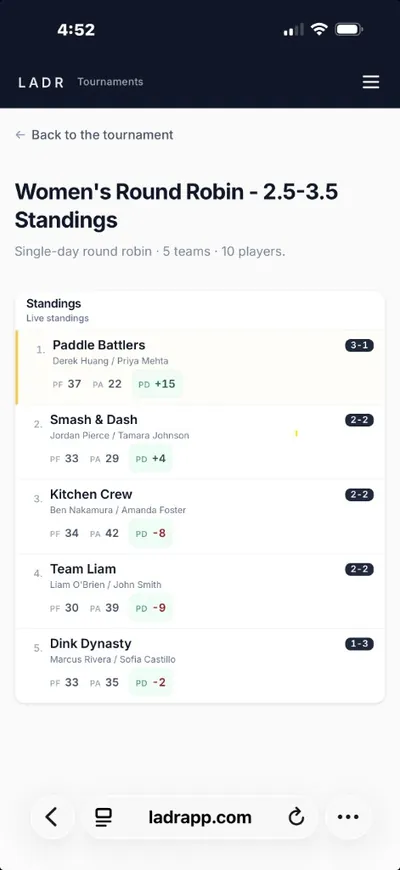
- Pods with their own standings
- Fair rotation between rounds
- Mixed-skill nights stay close
Pod play and round robin pools share a lot of DNA, see round robin pool workflows for the pool-first angle. If pod nights feed into a full club event, keep tournament software as the event hub players and guests open. Every pod screen is phone-first: it behaves like a pickleball tournament app but runs in the browser, so guests never have to install anything to follow their pod.
Why clubs run pod play (and where it breaks)
Pod play fixes “two courts of blowouts, four courts of bored players.” The mechanics are simple, the failure mode is always the sheet, not the format.
- Competitive games by design: pods keep skill spread tight, so every match stays interesting instead of one side cruising.
- Everyone plays, every round: small pods mean minimal idle time and no one aging out of the night on the bench.
- Movement feels fair: winners shift up, losers shift down, and the reason is visible in the pod standings, not the commissioner's head.
- Scales with court count: run three pods or thirteen; the organizer flow is the same, the standings page multiplies cleanly.
Free to start · no credit card
Set up your pod night in 2 minutesCommon pod play shapes
Pod play is a family of formats, not a single rulebook. Pick the variant that matches your club's vibe and court time.
Fixed-pod round robin
Each pod plays an internal round robin; standings close the night. Simple, fair, and easy to run without movement rules.
Up/down pod play
After each round, pod winners move up a pod, losers move down. Mixed-skill groups naturally sort toward competitive games.
Pod-to-bracket
Pods serve as a seeding round; top finishers advance into a bracket while the rest keep playing pod games.
Partner-rotating pods
Fixed pods, rotating partners inside each, useful when you want social mixing without breaking the pod structure.
How to run pod play with LADR
Pod night looks chaotic from across the gym. On a phone, it should be four taps: publish pods → run the round → enter scores → move players.
- 1
Draft the pods
Group players by rating, registration, or a simple draw. Each pod gets its own page with its own standings.
- 2
Publish the round
Pairings and court assignments land on the event link. Players check their pod, not the whole draw.
- 3
Score games courtside
Tap in results as courts clear. Each pod's standings update independently; you never wait for the slow court.
- 4
Move players between rounds
Apply your up/down rule once and the next round's pods are set. No whiteboard redraws, no chase-the-sheet drama.
FAQ: pickleball pod play
- What is pod play in pickleball?
- A format where players are grouped into small pods (typically three to six players each) that play a round robin or short rotation inside the pod, often moving between pods after a round based on results.
- Why is pod play popular?
- It gives mixed-skill clubs a way to keep games competitive without a strict bracket: every player gets matches, groups stay level, and organizers don't have to redraw a full event after every result.
- How is pod play different from a round robin?
- A round robin is one group playing all pairings. Pod play is many small groups, often with movement between pods between rounds, so you get the fairness of a round robin at scale, in a session-friendly block.
- Can pod play run on the same LADR event as brackets?
- Yes. Pod blocks can lead into brackets, seed a ladder, or close a league week, pods stay pods while advancement reads from the same source of truth.
- Do players need to understand the pod math to follow along?
- No. Each pod has its own standings view and next-up assignment, so players only track their pod, the overall structure stays in the organizer's hands.
Run your next pod night on one link
Free for pod play, no credit card needed. Set up three pods, publish the link, and see if the paper grid stays in the closet where it belongs.