DUPR Pickleball Software
LADR runs the club events that generate DUPR-reportable match results. Every tournament, league match, and ladder game produces a complete score record your DUPR coordinator can reference when submitting to DUPR, no piecing together screenshots after the fact.
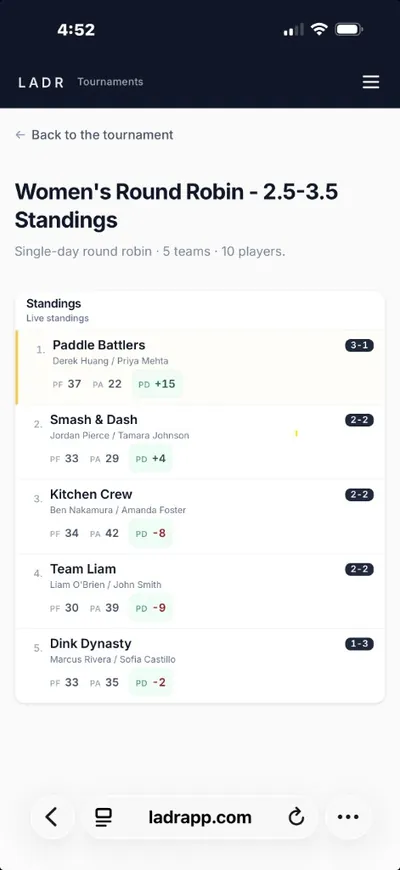
- Full match-by-match records
- Clean data for DUPR submissions
- Tournaments, leagues, and ladders
LADR does not replace DUPR, it runs the events that feed it. For a full picture of what LADR manages, start with pickleball club software or see how individual formats like tournament software and league software generate the match history your club cares about.
Why clean match records matter for DUPR clubs
DUPR ratings are only as trustworthy as the match data behind them. Clubs that run events on LADR arrive at submission time with a complete, verified record instead of a memory.
- Complete score history: every game, both players or teams, and the final score, recorded at entry time, not reconstructed from memory on Monday.
- Event context preserved: which event, which round, and which format each match came from, gives your DUPR coordinator the submission context they need.
- Participant records: players are attached to matches by name and profile, not an anonymous line in a spreadsheet.
- Organized output: results are structured by event rather than scattered across text threads, making post-event submission straightforward.
Free to start · no credit card
Run your first DUPR-ready event freeEvent formats that generate match records
These are the organized formats where individual match scores are captured, the type of results DUPR expects for rating submissions.
Club tournaments
Pool play and bracket rounds produce individual match scores with full player records, the primary source of DUPR-submittable data for most clubs.
Recurring leagues
Week-by-week match results accumulate into a season record. Each match is logged against both players' profiles for clean submission after the season.
Ladder nights
Challenge-based ladder matches are recorded individually, who played whom, what the score was, and when placement changed.
Round robin pools
Every pairing in a pool produces a logged match result. Pool-block events run in LADR give coordinators a full set of individual game scores to submit.
How LADR supports your DUPR workflow
LADR handles event logistics so your team focuses on play, and arrives at submission time with a complete record.
- 1
Run the event on LADR
Publish the draw, collect entries, and run live scoring, tournaments, leagues, or ladders all record match-by-match results automatically.
- 2
Score is entered at the source
Scorekeepers log results from the floor between games; each entry creates a timestamped match record with both players and the final score.
- 3
Review results after the event
The complete event history lives in one place, no collecting texts or photos to reconstruct who beat whom in round two.
- 4
Submit to DUPR
Your DUPR coordinator uses the LADR event record to submit results through DUPR's standard process. Clean input, less time reconciling.
A note on DUPR integration
LADR is not affiliated with DUPR. Automated DUPR result submission is in final testing and rolling out soon; until it lands, LADR generates the clean match records that make manual DUPR submission fast and accurate. When automated submission launches it will be included at no extra cost.
FAQ: DUPR pickleball software
- Does LADR integrate directly with DUPR?
- LADR does not have an automated API connection to DUPR today. LADR produces full match-by-match results for every event, which your club's DUPR coordinator can use to submit verified results through DUPR's standard submission process.
- What match data does LADR record per game?
- LADR records the players, scores, event context, and timestamp for each match. That gives your DUPR coordinator a clean record to reference when submitting results rather than piecing together notes from five different phones.
- Can LADR help us run DUPR-rated events?
- Yes. LADR handles the event logistics, draws, pools, brackets, live standings, so your team can focus on running a clean event. The match history LADR generates is the data your DUPR coordinator submits. LADR does not certify DUPR ratings itself.
- What event formats generate DUPR-reportable results?
- Any format where individual match scores are recorded, tournaments, round robin pools, league matches, and ladder challenges, generates a match history that can be used for DUPR submissions. Open play and drop-in sessions without fixed match records generally do not qualify.
- Is LADR only useful for DUPR clubs?
- No. The majority of LADR clubs use it for internal standings and organized play without any connection to DUPR. DUPR reporting is one downstream use of the clean match data LADR generates, not a prerequisite for using LADR.
Run the events behind your DUPR ratings
No credit card to get started. Publish a tournament or league, collect match results from the floor, and give your DUPR coordinator a complete record to work from.