Pickleball Mixer Software
For the night where the point is to meet new people, not crown a champion: rotate partners every round, avoid repeat pairings, and give the room a fair shake without you re-doing the bracket on a napkin between games.
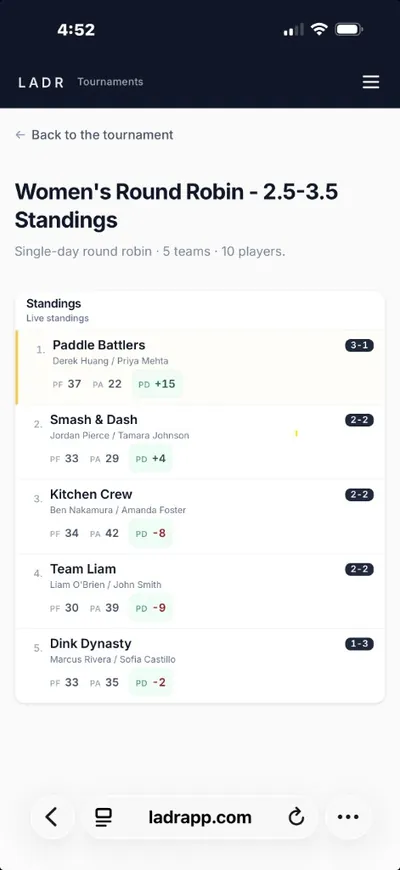
- New partner every round
- No repeat pairings until math forces it
- Standings from real games, not vibes
If the room is fixed teams who want a sequence of head-to-head games, you want a round robin instead. If attendance keeps shifting week to week, lean into social league software and use mixer rotation inside it.
Why mixers need software, not paper
The work in a mixer is not running the games, it is generating fair rotations on the fly when the player count is odd or someone leaves at round four. That math is what burns volunteers out.
- Rotation that respects the math: with N players and N rounds, the schedule avoids repeat partners as long as it can — instead of you eyeballing it.
- Sit-outs handled gracefully: odd player counts and late drops still get a fair distribution of court time; no one sits out twice in a row.
- Skill bands if you want them: balance pairings by rating so the 3.0 doesn't end up across the net from the 4.5 every round.
- Standings that earn it: games count toward a personal record, partners shuffle, so the leaderboard reflects how the player did across many partners — not luck of the draw.
Free to start · no credit card
Run your first mixer freeMixer shapes we see in the wild
Same engine — rotating partners, balanced schedule — applied to whatever room you're trying to make welcoming tonight.
Bring-a-friend mixer
Members invite neighbors. The point is for the guest to leave with three new contacts and a story, not to feel like they crashed someone else's league.
Singles & dating-style mixers
Pairs rotate every round, scoring is incidental. Software handles partner assignment without making it weird.
Skill-band mixers
3.0–3.5s want to meet each other without being eaten alive. Bands keep games competitive while partners still shuffle.
Corporate & charity nights
Strangers from three departments. Five rounds, four new partners each, easy results email after.
How a mixer runs
Three minutes to set up, six rounds of pickle, one standings link. The middle is where most software fails — we focus there.
- 1
Set rounds + courts
Tell LADR how many courts you have and how many rounds you want. It figures the rotation math.
- 2
Players show up, you check them in
Walk-ins, no-shows, late arrivals — adjust the roster before round one and the rotation re-balances.
- 3
Round 1 generates
Partners and courts post to the shared link. Players see who they're with and where.
- 4
Scores roll into standings
Enter each game's score on a phone. Personal standings reflect how each player did across all their partners.
FAQ: pickleball mixer software
- What is pickleball mixer software?
- Software for rotating-partner socials: every round you get a new partner and new opponents. The schedule avoids repeat pairings as long as the player count allows, so the room actually mixes.
- How is a mixer different from a round robin?
- A round robin is fixed teams playing each other in sequence. A mixer shuffles partners every round, so the same person plays with — and against — many different people across the night.
- Do players need an account or app?
- No. Players follow the night in the browser from the link you share. Their next partner, court, and opponents are on the page; no logins to hand out at the door.
- Can the pairings respect skill levels?
- Yes. Use skill bands so weaker and stronger players still get balanced matchups across the night. Or leave it pure-rotation if the room is roughly even.
- What if a player shows up late or leaves early?
- Remove them from the round before generating the next schedule. The rotation re-balances around whoever is actually on court.
Spin up a mixer in three minutes
Free for socials. Set courts and rounds, share the link, let the math do the partner-shuffling so you can stand at the door instead of the spreadsheet.